

Gemologist and Color Stone Enthusiast

Last week I wrote about ugly little plastic bags.
The ones full of inherited jewelry, loose stones, broken mountings and 30 years of things nobody quite remembers buying.
That article was really about scale.
An enormous amount of jewelry is going to change hands over the next couple of decades, and somebody is going to have to figure out what all of it is — and, more importantly, what it is worth.
Here is the part I deliberately left out:
Sometimes a stone will make your life ridiculously easy.
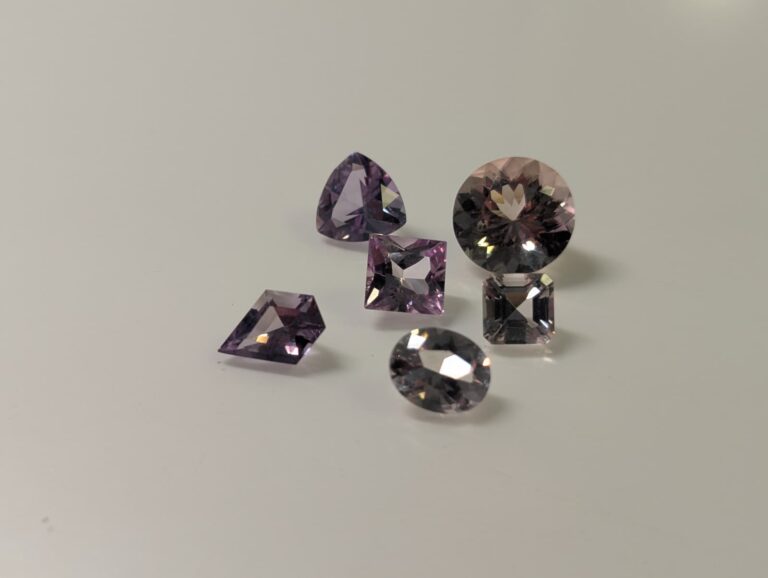
Take the group in this photograph.
At first glance, we have a handful of pale pink-to-purple transparent stones.
Nothing particularly terrifying.
But in the real world, especially when you are buying rather than writing a laboratory report, you may be looking at dozens or hundreds of stones in a sitting.
And pale pink is a crowded neighborhood.
Kunzite.
Morganite.
Rose quartz.
Rose de France amethyst.
Pink sapphire.
And assorted other things pretending they belong at the party.
You can start running every conventional test on every stone.
Or you can ask the pile a better question first.
Turn the light on.
One of the tools I keep close at hand is a simple 405 nm violet-light source.
Hit this particular group with it and suddenly one of the stones practically raises its hand.
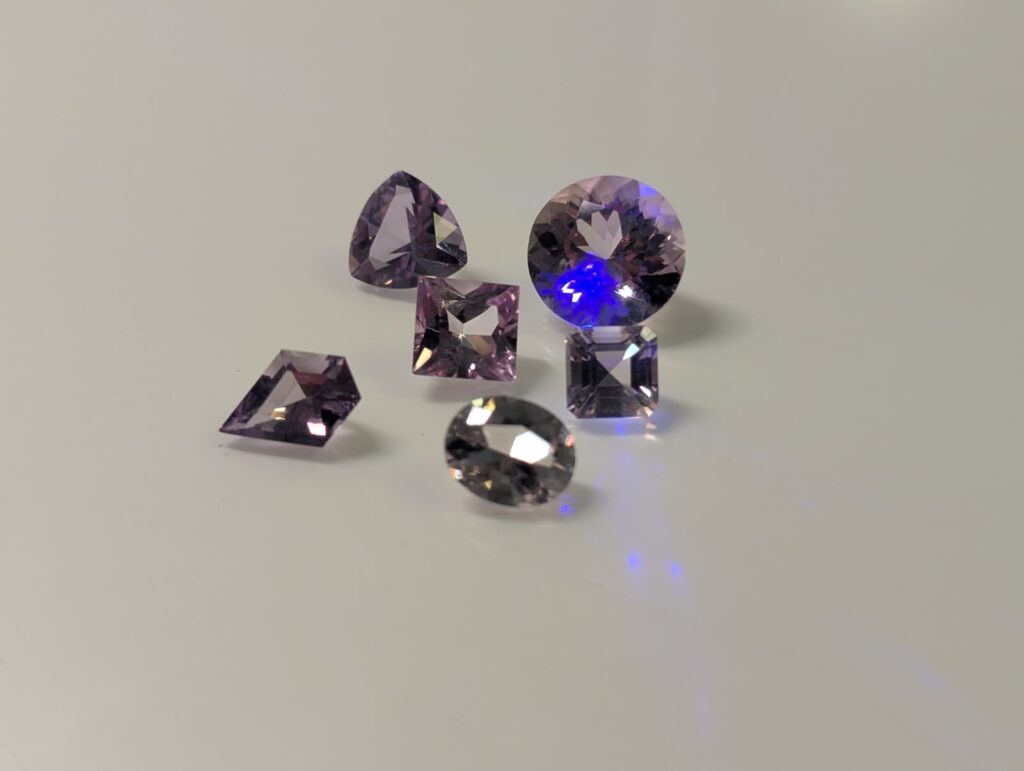
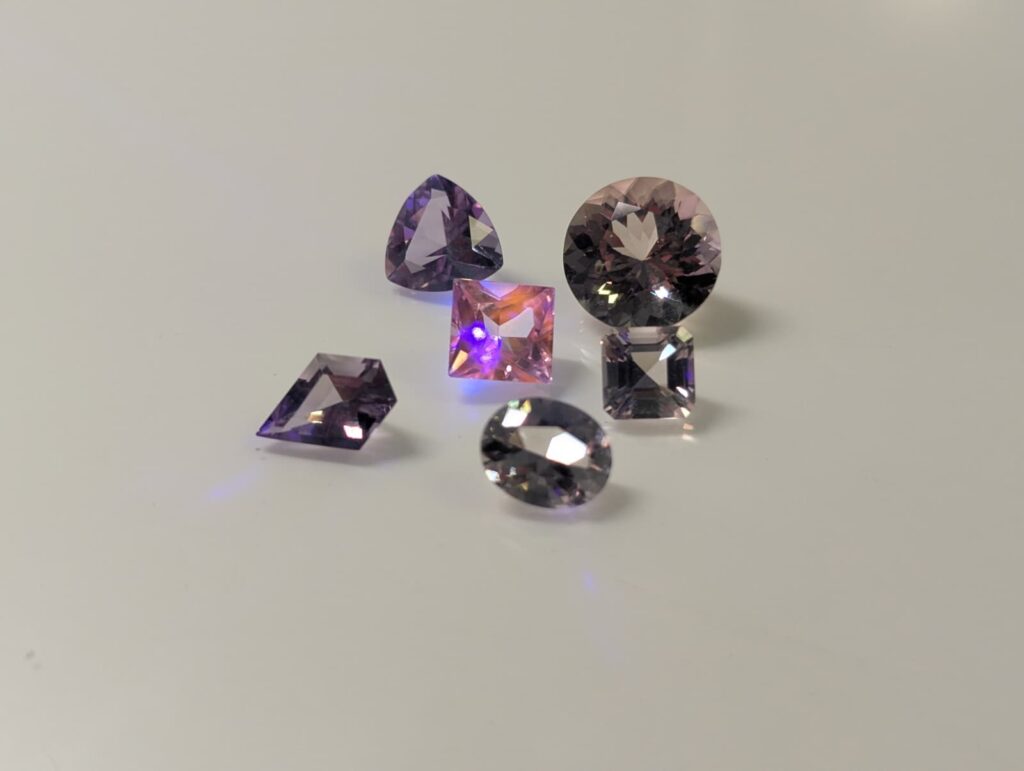
The kunzite produces a striking, somewhat chalky orangish-pink response that is dramatically different from the relatively quiet stones sitting around it.
That reaction is useful.
But the important word there is useful.
Not diagnostic.
Fluorescence is not an identification.
Pink sapphire can light up too.
In fact, chromium-bearing pink sapphire can fluoresce a strong red — sometimes an absolutely furious coal-red that looks nothing like the softer orangish-pink response I am seeing from this kunzite.
Could I identify a pink stone as kunzite solely because it fluoresced?
Absolutely not.
That is how perfectly intelligent people eventually buy very stupid rocks.
But that is also missing the point.
I am not trying to finish the identification.
I am trying to decide where to spend the next five minutes.
That is the difference between laboratory gemology and buying triage.
If I have five pink stones on my desk and one gives me an immediate, distinctive reaction, I have just reduced the problem.
Now I know where to look next.
Maybe I check pleochroism.
Maybe I go to refractive index.
Maybe the inclusions, optic character or other observations already give me the rest of the answer.
The fluorescence did not identify the stone.
It told me which question to ask next.
And that is where these inexpensive little tools become enormously powerful.
Not because any one of them replaces gemology.
Because several very fast observations, stacked together, can turn what initially looks like a mess into a remarkably small number of possibilities.
That is essentially how I approach parcels.
Probably because I came into this business with one foot in gemology and the other still firmly planted in geology.
A geologist rarely looks at one isolated property and declares victory.
You look at populations.
Textures.
Structures.
Associations.
Behavior.
You keep eliminating things that do not make sense until what remains begins to tell a coherent story.
Gem buying, at least the way I practice it, works remarkably similarly.
And sometimes the first chapter of that story can be revealed with a light small enough to fit in your shirt pocket.
There is a lot more to this than shining purple lights at rocks.
That rabbit hole is part of what I’ll be digging into at AGS Conclave 2026 in Secret Teachings of a Gem Buyer.
I’m not planning to give the whole presentation away on LinkedIn.
But I may leave a few more carrots lying around between now and September.