
Some of it Is sitting in a Jewelry Box.

Gemologist and Color Stone Enthusiast
I have developed a healthy distrust of ugly little plastic bags.
In my world, the good stuff rarely arrives looking like good stuff.
It comes across the table in a Ziploc bag. A coffee tin. An old jewelry box with a broken hinge. Somebody’s grandmother wore it. Somebody’s father put it in a safe-deposit box sometime during the Reagan administration. Nobody remembers what was paid for it, and the appraisal from 1994 tells me remarkably little that I actually want to know.
Then, every once in a while, tucked between the broken chains, class rings and single earrings, there is a stone that makes you stop.
We are going to be seeing a lot more of those bags.
UBS, the Swiss wealth management firm, estimates that roughly $83 trillion in private wealth will move from one generation to the next over the coming decades as part of what has become known as the Great Wealth Transfer. UBS itself calls the largest wealth transfer in modern history (UBS Global Next Generation Report 2026).
Economists see $83 trillion changing hands. I see jewelry drawers opening.
The American Bar Association‘s own trust and estate section recently described what it calls a coming “probate storm” as the Baby Boomer generation ages and an enormous amount of property begins moving through estates, trusts and families.
Jewelry is part of that property.
And I don’t think the jewelry trade has completely wrapped its head around what that means yet.
For decades, we have called this the secondary market.
Technically, that’s correct.
But when estate jewelry becomes one of the places where meaningful quantities of fine natural diamonds and colored stones are actually entering the market (not just as part of the wealth transfer, but also due to political sanctions and tariffs on imports), “secondary” starts sounding a little misleading.
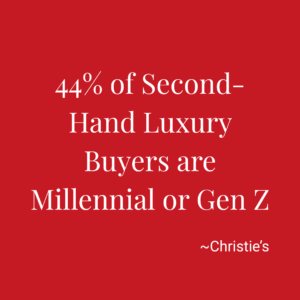
And it is not just the supply side that is being affected by the secondary market growth phenomenon; the demand side is matching its energy. Bain & Company’s “Luxury Goods Worldwide Market Study found that second-hand jewelry is increasingly becoming a gateway into the luxury market, for a younger generation (Bain & Company, via National Jeweler). Christie’s for example closed 2025 with luxury sales up 17 percent to $795 million. Millennials and Gen Z made up 44% of its luxury buyers and bidders, and they were specifically drawn to colored gemstones and pieces with a story (Christie’s coverage; FashionNetwork). This isn’t a category quietly winding down. It’s where future purchasing power is moving.
The secondary market should no longer receive your secondary attention.
If you are going to be active in this lucrative market, there are a few things I need to draw your attention to.
Some of this material hasn’t been available to the trade in forty, fifty or seventy years.
There are old mine diamonds that were cut by somebody who never heard the words “Excellent Cut.” There are rubies and sapphires purchased before modern treatment disclosure became part of the everyday vocabulary of our business. There are signed pieces nobody in the family recognizes, oddball cuts that haven’t been commercially fashionable in generations, and very occasionally a genuinely important stone sitting in a genuinely awful mounting.
That last part happens more than people think.
And finding it is only half the problem.
You still have to know what the hell you’re looking at.
An old mine cut was made according to a completely different set of priorities than a modern round brilliant. Higher crown. Smaller table. Large culet. Hand-cut symmetry. Different light behavior. Different personality.
Put modern expectations on an antique diamond, and you can completely miss why the stone matters.
The opposite mistake is just as expensive.
Age is not a gemological treatment.
A ruby can have been sitting in Grandma’s jewelry box for thirty years and still be glass filled. A sapphire can come out of a beautiful old mounting and still require more investigation. Provenance may make a stone interesting. It does not make it innocent.
That is where the buyer’s job gets fun.
And occasionally expensive.
At a buying table, I usually don’t have three days, a committee meeting and six laboratory reports to decide whether something deserves my attention. Sometimes I have a few minutes while another twenty pieces are sitting beside it.
So you learn to look:
Most importantly, you learn that identifying a gemstone correctly is only the beginning of the conversation.
A gemologist needs to know what it is.
An appraiser needs to understand what it is worth in the appropriate market.
A buyer has one more unpleasant little question:
What can I actually do with it?
That is the part of gem buying that has always fascinated me.
I spend my working life evaluating post-consumer diamonds and colored stones as they come back into the trade. Some are exceptional. Most are ordinary. A few are badly misunderstood.

Those are usually the interesting ones.
This September I’ll be at the American Gem Society’s Conclave in Orlando talking about exactly that in “Secret Teachings of a Gem Buyer: Field-Tested Techniques for Unlocking Value in Estate Jewelry.”
This isn’t going to be a lecture about how to use a loupe.
There will be a room full of people who already know how to use a loupe.
I want to talk about what happens around the gemology: the observations, shortcuts, warning signs, unconventional tools, recutting decisions and little bits of accumulated scar tissue that affect what a buyer actually does when the stone is sitting on the table and money is attached to the decision.
Between now and Conclave, I’m going to unpack some of that here.
Not everything…
I need somebody to still come to the damn class.
Next week I’ll start with what I look at before the loupe ever comes out.
Because sometimes the most valuable thing on the table is the stone everybody else has already decided is ugly.