

Gemologist and Color Stone Enthusiast

Look at the emerald first.
Just look at it.
Green. Included. A few fissures. Nothing terribly dramatic.
Now watch what happens when I put 405 nm violet light on it.
There.
That.
The stone suddenly lights up with a branching, glowing spiderweb.
Fractures run through it in every direction. Fine ones. Heavy ones. Interconnected ones. Things that were barely noticeable a second ago suddenly look as though somebody has drawn a road map through the emerald with fluorescent ink.
And this is why I love simple gemology. I haven’t cut the stone open. I haven’t sent it to a laboratory. I haven’t even changed the emerald.
I changed the light.
And the stone gave me information I couldn’t see before.
Those fractures did not suddenly appear. They were already there. What changed was the contrast.
Surface-reaching fractures in gemstones can be filled with another material to make them less visible. In emerald that very often means oil, resin or another clarity-enhancing substance. The filler gets into the fissure and reduces the optical contrast that made the fracture so obvious when it contained air.
The result can be dramatic.
The emerald looks cleaner. The fissures become less distracting. And everybody is happier.
Except the fissures haven’t gone anywhere.
We haven’t healed the crystal. We have hidden some of the evidence.
That distinction matters.
And No, Oiling Isn’t Just an Emerald Thing
Emerald gets all the attention because clarity enhancement is so deeply associated with the material. Mention an oiled gemstone to most jewelers and their brain immediately goes: Emerald. Cedarwood oil. Next question.
Nature and the gemstone trade are considerably messier than that.
Tourmaline, for example, has also appeared in the market with surface-reaching fractures filled with oils and resins. This has included valuable material such as Paraíba, rubellite and bicolor tourmaline. Change the filler and the same basic idea extends farther.
Rubies can have extensive fractures filled with glass.
Diamonds can have surface-reaching fractures filled with glass-like material.
Resins or glasses can potentially be used in fractured quartz, aquamarine, topaz, tourmaline and other transparent gems as well.
So I don’t want you walking away from this thinking: 405 nm + glowing fractures = oiled emerald.
That isn’t the lesson.
The larger lesson is: People have been putting things into holes in gemstones for a very long time. And occasionally the light lets us catch them doing it.
Now Watch the Video Again
This is the part I want you to actually watch.
Ordinary light. 405 nm on. Ordinary light. 405 nm on.
The transformation is immediate.
Under the violet excitation, the material occupying parts of those fissures responds differently from the emerald around it. And suddenly the treatment helps draw its own map. That glowing material traces the fractures for you. The spiderweb isn’t merely pretty fluorescence. It is showing you where to look.
Fluorescence is especially useful here because fillers in clarity-enhanced emeralds can fluoresce differently from the host stone – sometimes blue, green, yellow or a mixture when more than one material is present.
That is the magic.
The filler was introduced to make the fracture harder to see. Then I change the illumination…and the filler helps me see it again.
Come on.
That’s cool.
Now we slow down.
Can I look at that glowing network and tell you with absolute certainty that it is cedarwood oil?
No. And I don’t need to pretend I can.
Emerald fillers can include essential oils, other oils, waxes, epoxies, polymers and other resin systems. An emerald can even have been filled more than once over its life, potentially with different substances.
What the 405 nm observation gives me is evidence.
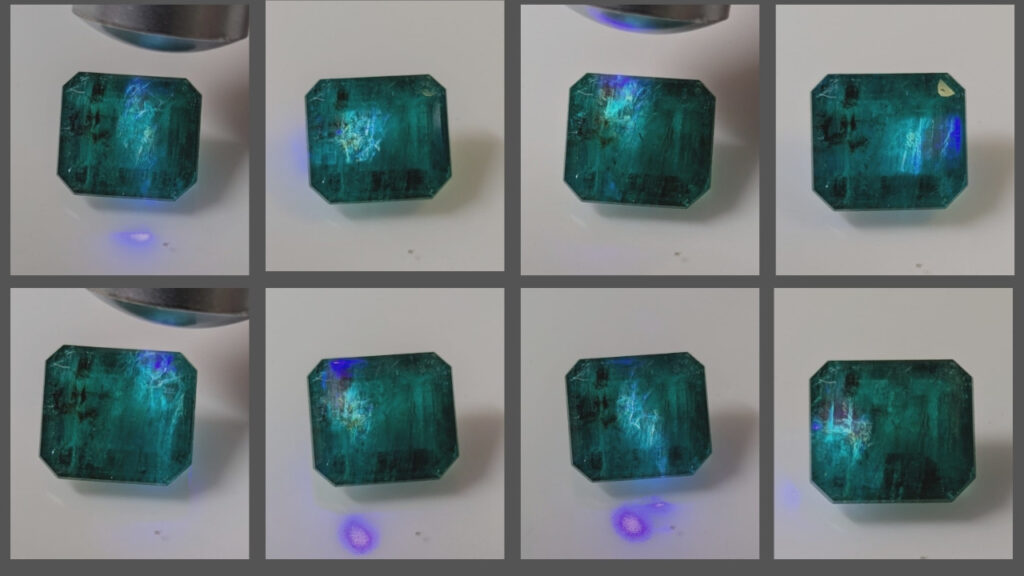
Something in those fractures is behaving differently. The pattern corresponds beautifully with a fracture network. That immediately makes the treatment history of the stone a much more interesting question. Now I know where to put the microscope. Now I know what I need to investigate.
And from the buyer’s side of the table, that is already enormously valuable.
I’m buying the emerald underneath it.
That is the part people sometimes forget. When I buy a clarity-enhanced emerald, I’m looking at two things at once:
Those are not quite the same thing.
Look at that video again and imagine removing the material from every one of those glowing fissures.
And perhaps most importantly:
Now we’ve moved a very long way from a pretty fluorescence demonstration.
Now we’re talking money.
This is where my world gets entertaining.
An emerald walks across the counter in an old ring. There is an appraisal from 1987. It says “fine Colombian emerald.”
Excellent!
There is absolutely nothing on the paperwork about treatment.
Also excellent!
The owner remembers having the ring cleaned somewhere twenty years ago.
Maybe…
She thinks.
Her mother may also have had something done to it.
Possibly…
And now I get to figure out what I’m buying.
Welcome to estate jewelry. I don’t know who has touched that emerald. I don’t know whether it was filled when it was cut. I don’t know whether somebody cleaned it, refilled it, re-oiled it or introduced something different later.
What I have is the stone in front of me. So I start asking it questions.
And sometimes all it takes is changing the light.
This isn’t only about value.
Fillers have different degrees of durability. Heat, chemicals and cleaning processes can alter or remove some filling materials, and emeralds with filled fractures deserve particular care around ultrasonic and steam cleaning. Which means that identifying evidence of filling can change what I do before I ever put a tool near the jewelry.
That glowing spiderweb has now given me information about identification, treatment, value and repair risk.
Not bad for a flashlight.
People sometimes look at the stuff I carry around and assume I’m trying to build a portable gemological laboratory.
I’m not. I’m trying to ask stones questions quickly.
That’s a very different objective.
I don’t need every tool to give me a final identification. I need it to change what I know.
Five seconds ago:
Emerald. Looks pretty good. Some fissures.
Five seconds later:
Geez. Look at that fracture network.
That is progress. Now I know something I didn’t know before. Now I know where to look next.
This is exactly the kind of thing I’ll be playing with at American Gem Society Conclave this September in Secret Teachings of a Gem Buyer.
📆Sep 15 @02:30pm 📍Olympic A
Not because a 405 nm light magically identifies emerald treatments.
It doesn’t.
And not because fluorescence replaces the microscope or the laboratory.
It doesn’t do that either.
I like it because it makes the invisible visible. It gives me another piece of evidence. And sometimes it does it in spectacular fashion.
Turn the light off and the spiderweb retreats.
Turn the 405 nm back on… and there it is.
Same emerald… Same fractures… Same stone…
Nothing appeared. Nothing disappeared.
For a few seconds, we simply convinced the gemstone to stop hiding it from us.
The fractures never went away.